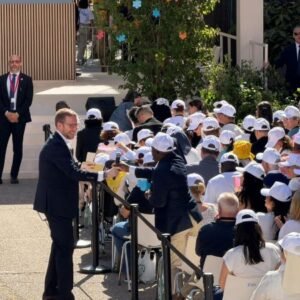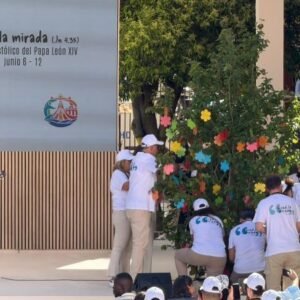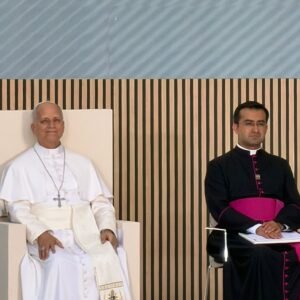

People from various NGOs and foundations took part in this meeting, among them two volunteers and a beneficiary of the Aula Abierta-Catalejo Project of the Augustinian Network for Education and Development Foundation (REDA), a non-profit organization of the Order of Saint Augustine that runs socio-educational projects in Spain for people in vulnerable situations. Fr. Jaazeal Jakosalem, president of ARCORES International, also took part.
The REDA Foundation also supports cooperation projects in other countries and carries out awareness-raising work in coordination with the Secretariat for Missions, Justice and Peace of the Augustinian Province of Saint John of Sahagún.
The Cardinal of Madrid
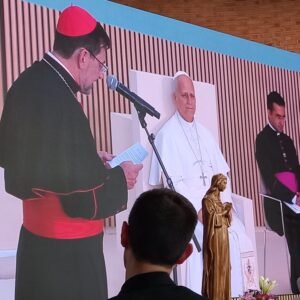
At this Caritas centre in Madrid’s Carabanchel district, the Cardinal Archbishop of Madrid, José Cobo, addressed the first words to the Pope on behalf of the local Church, which he described as welcoming and open, a place where the Christian community has been built by people who have come from many places.
He highlighted the meaning of beginning the visit in a humble place linked to the most vulnerable because, according to the Gospel, it is from their perspective that Christ’s presence and the Church’s mission are best understood: “The Gospel is better understood when reality is seen from the side of the least. In places like this we learn every day that Christ not only sends us to the poor, but makes himself present in them. That is why beginning in this way is not just a pastoral choice: it is also a confession of faith that we make together with the Pope.”
Referring to the motto, the cardinal stressed that “lifting up our eyes” must be done without losing touch with the concrete reality of those who struggle with housing, employment, loneliness or exclusion. In this context, he highlighted the social work of the Church in Madrid, especially through Caritas, consecrated life and many pastoral initiatives that accompany thousands of people.
Finally, he noted that it is precisely the poorest who offer the first greeting and embrace to the visitor, on behalf of the whole Christian community committed to service, prayer and solidarity.
The testimonies
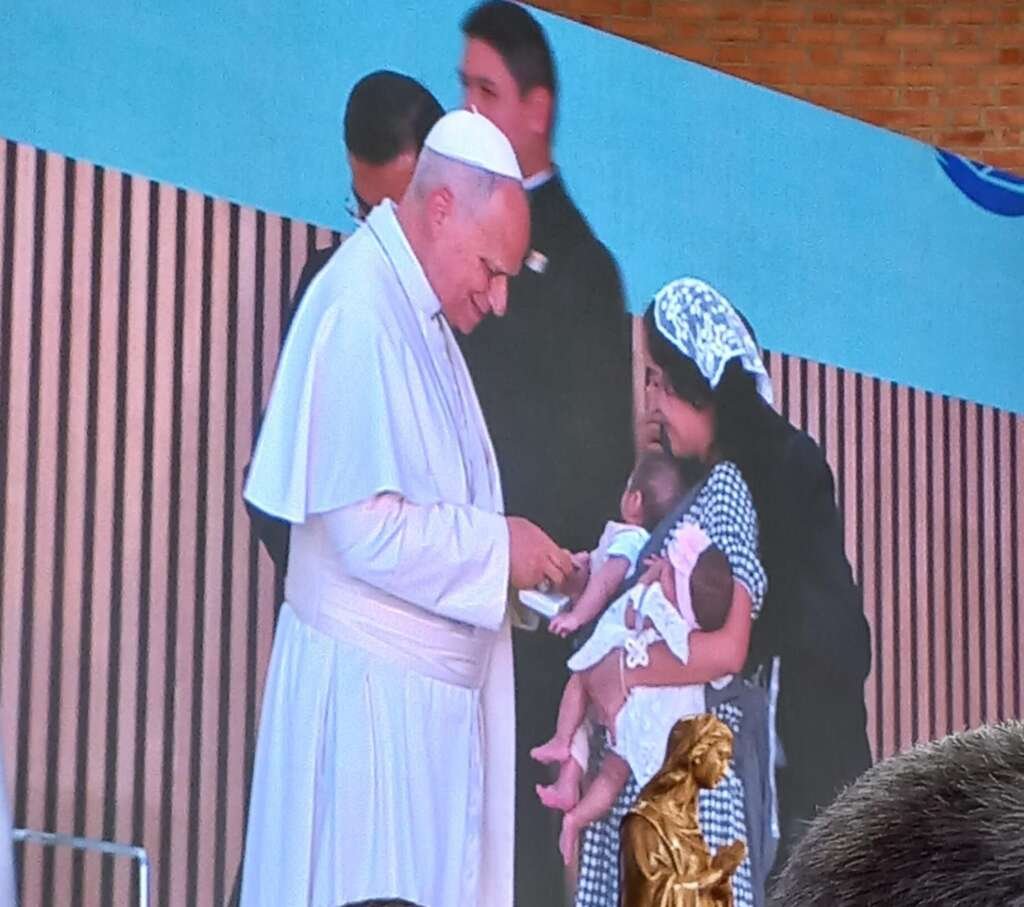
The Pope also heard the testimony of Niurca, a lawyer who came to Spain from Cuba a year ago, pregnant and not knowing how she would get by, but who found help at Caritas’ Santa Bárbara Home.
And that of Khadri, who arrived from Senegal in 2020, in the middle of the pandemic. He had left everything behind, didn’t know where to begin and felt alone: “At Caritas they helped me without asking me anything; they looked at me with respect and made me feel that my life mattered.”
And that of Alicia, a volunteer with the Adorers’ Proyecto Esperanza, who said that for volunteers, accompanying others is a way of proclaiming the Gospel.
Pope Leo XIV’s address
In his address, Pope Leo XIV spoke of the miracles that love works, and stressed the responsibility of Christians towards those in need: “A responsibility that consecrates every encounter with another person as a kairos, a unique and unrepeatable moment of grace to love, which must not be lost or postponed. The love of Christ urges us towards our brothers and sisters (cf. 2 Cor 5:14), and the charity and care with which we respond to its promptings are the proof of our faith.”
“Jesus’ words are also an invitation to cultivate a heart that is sensitive to the needs of others (cf. Ps 112:1-9),” he stressed, “keeping alive in us the desire for the good that God has placed in our own humanity and that faith sets free and strengthens.”
He also referred to the gifts Niurca, Khadri and Alicia gave him: “The ribbon with the children’s names expresses the joy that every birth brings to the world; the residence permit tells a story of effort, but above all of commitment, honesty and welcome; the sandal, which recalls Moses’ encounter with God on Horeb (cf. Ex 3:1-6), evokes the ‘holy ground’ we are bound to respect in every human life.”
Leo XIV’s visit to CEDIA 24 Horas put a face to a conviction deeply rooted in the Augustinian tradition: that God comes to meet human beings in their fragility, their need and their longing for a more dignified life. The stories shared, the commitment of volunteers and social workers, and the Holy Father’s words remind us that Christian charity is not only a response to poverty but a way of building community. As Saint Augustine taught, no one can find God by isolating themselves from others; it is in concrete love for our brothers and sisters that the heart discovers the way to the One who dwells in the depths of every person.