The journey is over, but the phrase from John’s Gospel that has accompanied us, “lift up your eyes,” does not end; it now becomes a real challenge. Nor does what must not be lost in the rush of time come to a close: all that was sown and lived in these days.
From the Canary Islands we lift up our eyes, recalling the ocean wave in the visit’s logo, which becomes a wave of love, of commitment, of newness: a wave with which the sea always washes the shore.
The Canary Islands have set the sea before our eyes and revealed it as what it always holds: depth, darkness, death, but also hope.
The sea and Saint Augustine
Looking at the sea, walking along its shore, focusing on it, is one of the images that proverbially bring Augustine to mind: Augustine on the shore, in the beautifully remembered story, trying to contain the mystery of the Trinity within his own thinking. But Augustine and the sea also come together in his life as a migrant who went to Rome to better himself, and in the hopes he gathered from so many people around the sea and the port of Hippo, which even led him, as Saint Possidius tells us, to sell chalices and sacred vessels to relieve people’s suffering. The sea is therefore a good setting for understanding Augustine’s thought and for remembering how this Augustinian, Pope Leo XIV, opens our eyes so that we look at the sea from the land and also look at the land from the sea.
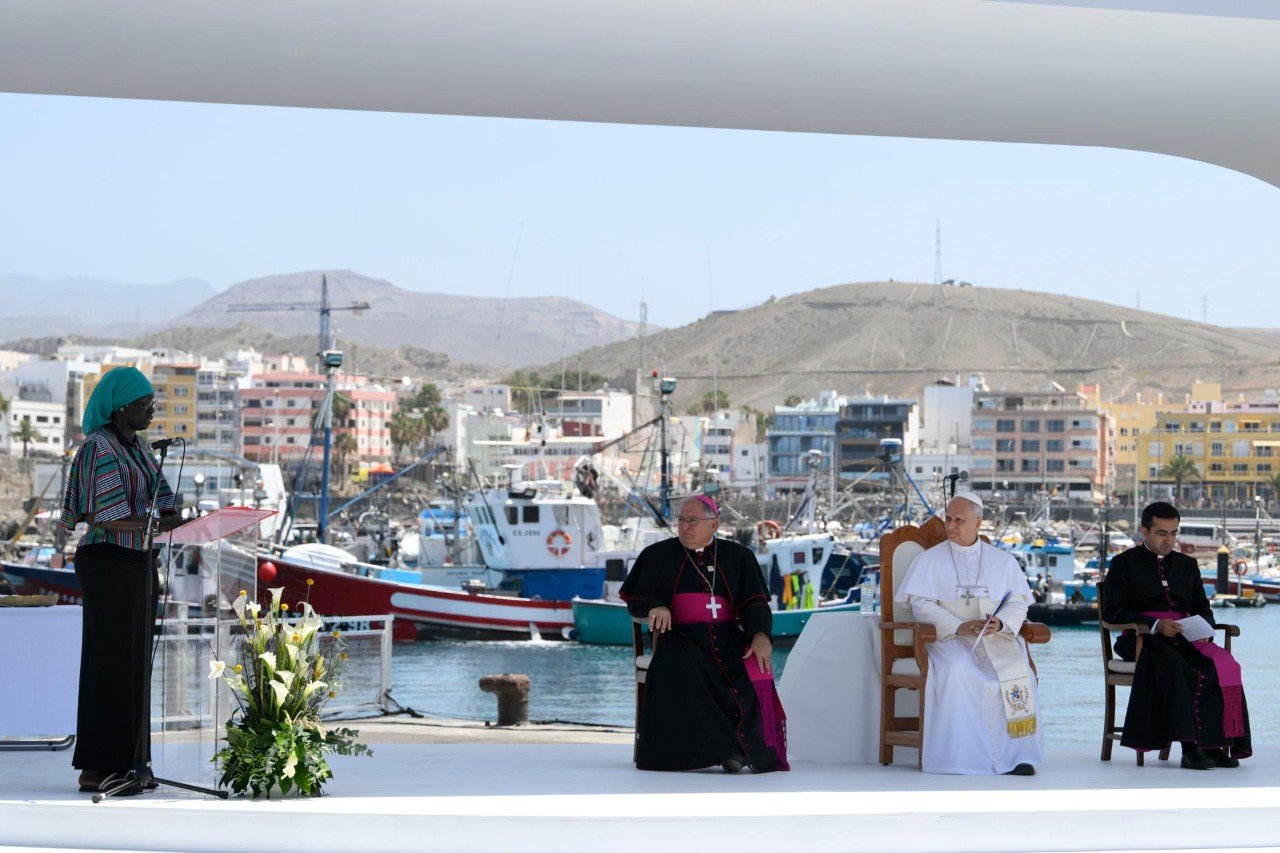
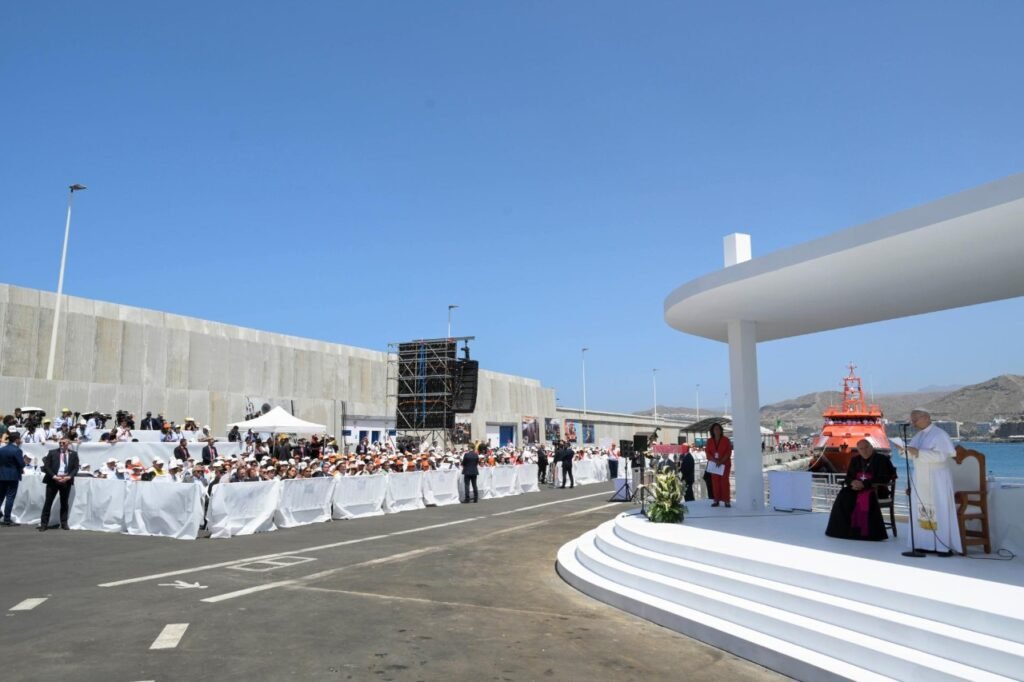
These may be the two dimensions of Pope Leo XIV’s message in the Canary Islands. Looking from the land to the sea, and thus understanding the needs of all those who arrive by sea precisely to find a better horizon, has been the great theme of welcome that he emphasized above all in Las Palmas. He stressed this welcome especially in his address at the port of Arguineguín, with profound words underlining that beside the sea, words necessarily become concrete. Beside the sea he felt like a fisherman; he showed us his seal and told us clearly that the successor of Peter cannot turn his back on the sea and on what happens on the docks. The Church cannot turn its back on the waters or on any place where there is hunger or fear. The sea can be tragic, but there is one who calms the sea, Christ Jesus, and because he calms the sea, the Church cannot remain silent before those who are abandoned to its waters.
On welcoming migrants, he stressed that it is not about solving everything but about being present wherever human beings suffer; we must recover the common language of welcome and love. Even when resources are lacking, gestures can always speak, gestures that go beyond words and, as he recalled in Tenerife, help through other languages: that of Thomas and of touch. Touching the wound, the reality of the other, necessarily creates a new language to which the Church and society are called.
The migrant and his face, the sea he comes from and the tragedy he lives through must become, the Pope stressed, a true examination of conscience: for countries of origin, which must create conditions of peace, justice and development; for transit countries, called to protect the weak and not leave them in the hands of criminal networks; for Europe, which cannot proclaim human dignity and grow used to the Mediterranean and the Atlantic being cemeteries without headstones; for the international community, called to effective and persevering cooperation; and also for the Church. Welcoming migrants cannot be something secondary or delegated to a few volunteers. Every boat that arrives with migrants is a wake-up call to the conscience of whoever kneels before the altar of Christ in the Eucharist and who must also kneel before their brother or sister, because every cayuco brings not only migrants but also a question that must pierce our conscience: what kind of world have we built if so many brothers and sisters must risk death in search of life?
Welcome and dignity
In welcoming migrants, the Pope sings the praises of human dignity. He calls for legal routes of rescue and assistance and clearly states that there is a right not to have to emigrate: a right to remain in one’s own home, in the land where one was born, which social conditions must make livable.
A livable home and society of which we must be wise architects. His nod is clear: to build not a new Babel but a true civilization of love, based on two fundamental attitudes. The first is to embrace the cross of Christ, an attitude he illuminated with a text from Saint Augustine’s commentary on the Gospel of John: facing the far shore and the stormy sea, the believer always has a piece of wood with which to cross over, the cross of Christ. We must embrace that cross and carry it like Simon of Cyrene so that others too may live, cross over and reach the shore. This gives rise to the second attitude that a good architect must have: cultivating a true Eucharistic spirituality, one that speaks of solidarity that becomes food, which is what we are precisely when we are able to nourish and help others, when we are Eucharist, that is, love that becomes food in welcoming, listening, closeness and care for the most fragile. This is what we must be in order to build the civilization of love and keep sailing courageously in this new time in history.
Helping us in this is today’s feast of the Sacred Heart of Jesus, with its key idea that love is repaid with love: fixing our eyes on the loving face God turns toward us and recognizing in it the path of life, so as to learn a way of living, of judging and of relating to others, and expressing it, like the Sacred Heart, in gratuitousness and humility, recognizing the words of Saint Augustine the Pope quoted today: “where there is charity there is peace, and where there is humility there is charity.”
Integration
But it is not enough to welcome; we must also integrate, and this idea of integration was the leitmotif of today’s visit to Tenerife.
It followed a magnificent address by the Minister of Inclusion, who recalled three foundations for the task ahead in the face of human migration: humanity, regulation and coexistence, knowing that this is only possible as an echo of love. The minister paraphrased 1 Corinthians 13.
In a lovely gesture, the Pope gave his address in French so that French-speaking immigrants could understand him more easily. He spoke of the task that belongs to those already on land: helping everyone feel the land as their own. Integrating through real education and training in language and trades, moving beyond the idea of migration as mere welcome and arrival, toward a single new reality that brings together those who are here and those who arrive, without forgetting one’s own origins. We must remember that we are all migrants, all pilgrims on the way to our heavenly homeland, the Pope stressed, with a deeply Augustinian echo.
Integrating, then, does not mean erasing one’s own history but entering a process of commitment that welcomes and includes, helping people cross the threshold of distance, that supports and rebuilds precisely because it embraces the future.
From this it follows that those who are integrated are also responsible for building a future, a new relationship. He clearly asked Catholics that integration not be merely a social task, but that at its heart there be a true evangelization of both those who receive and those who arrive, knowing and acknowledging that without integration people will be pushed into a second shipwreck, worse than the first one that sadly still happens. Worse, if anything, because it shatters the future.
The Pope also issued a firm and stern warning to all those who exploit despair. In a powerful and memorable passage he cried out: “Stop and be converted. The tears and blood of your brothers and sisters cry out to God, and their sufferings reach him. Money wrenched from the vulnerability of the poor will bring neither peace, nor honor, nor a future. Break the chains and free those you hold under your control; give back what you have taken and make amends as far as you can, and so obtain the mercy of God, which can always reach even the greatest sinner.”
And the Pope said goodbye thinking once more of the sea, the sea that from the port of Tenerife evokes the infinite, the port from which he urged us to turn our eyes to the Cross, the Cross present in the very name of the city of this port. Lift up your eyes and see the cross. Lift up your eyes to Christ crucified, Lord of mercy. Lift up your eyes to find peace, lift them as Mary did, and with her set out again on the path of hope.
PHOTOS: © Vatican Media