

Leo XIV and Saint Augustine: What is the ‘scent’ of a good teacher?
In Uruguay, Leo XIV revives Saint Augustine's pedagogy to remind us that educating means accompanying towards the truth and shaping hearts.
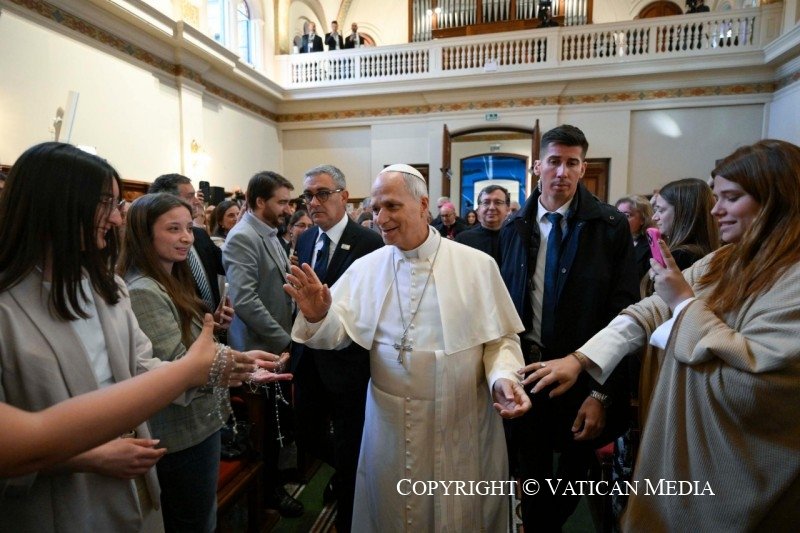
In his encounter with the educational world of Uruguay, Leo XIV revisited two insights from Saint Augustine to remind us that educating is not merely about transmitting knowledge, but about accompanying towards the truth and shaping hearts. This is not the Holy Father’s first speech during this apostolic journey, but it is the first in which he explicitly quotes our father Saint Augustine. Friar Alfonso Dávila, an Augustinian Recollect, journalist, and former university chaplain, shares a personal reflection on the ‘aroma’ of good teachers, the mark they leave on our lives, and the responsibility of educating from the heart as well.
What is the ‘scent’ of a good teacher? It might seem like a simple question, but upon hearing the words Leo XIV addressed to the educational world of Uruguay, I immediately remembered a teacher from my childhood and adolescence. I perfectly recall his ‘aroma.’ And I don’t just mean how he smelled, but what he conveyed to me: his closeness, his way of teaching, the trust he inspired, and that imprint that, many years later, is still part of my memory.
Curiously, years later, during my university studies in communication, I discovered that this is also a question posed by marketing. Brands seek to build a sensory identity, an ‘aroma’ that makes them recognizable and memorable to people. This is known as olfactory marketing.
But what happens when we transfer that question to education? What does a teacher ‘smell’ like? What remains of them when their classes end?
Leo XIV invites us to consider these questions through Saint Augustine. And he does so with two insights that help us understand the true responsibility of educators: to accompany towards the truth and to transmit, through one’s own life, what is taught.
Saint Augustine: Teaching is accompanying towards the truth
In his address at the Catholic University of Uruguay, the Pope reiterated an idea from his apostolic letter Designing New Maps of Hope, published in October 2025:
“The authentic teacher awakens the desire for truth, educates freedom to read the signs and listen to the inner voice.”
Leo XIV, Designing New Maps of Hope, 2.2.
This is one of Saint Augustine’s great contributions to education. In his work De magistro, the Bishop of Hippo explains that the external teacher helps through words, but the true discovery of truth happens within the person, where Christ is the inner Teacher.
From this perspective, the teacher does not own the truth nor is called to impose it. They are someone who accompanies, sparks questions, teaches discernment, and helps discover what gives meaning to existence.
And accompanying requires much more than mastering a subject. It demands listening, understanding each student’s pace, recognizing their difficulties, and helping them discover their abilities.
The educator’s responsibility does not end when their students learn a lesson. It is not enough to form minds capable of thinking; we need to shape hearts capable of loving, discerning, and seeking the truth.
The good ‘scent’ of the teacher: a lesson that endures
The second Augustinian reference appears when Leo XIV speaks of the sense of smell. Recalling Jesus’ anointing in Bethany, the Pope quotes Saint Augustine:
Perfume becomes an image of the good that a life communicates to others. The Pope connects this insight with human dignity and the responsibility to build a society where no one is discarded.
But this image also allows us to return to our initial question: What is the ‘scent’ of a teacher?
We all remember teachers who taught us more than just a subject. Their patience, enthusiasm, high standards, or their way of treating us left an imprint that we still recognize.
Because an educator transmits much more than what they explain. Their way of correcting, of accompanying those with difficulties, of listening to those who think differently, or of acknowledging their own mistakes also educates.
And here appears a profoundly Augustinian demand: before asking ourselves what we want to transmit to our students, we must ask ourselves what we carry within.
We cannot teach mercy from indifference, respect from humiliation, or love for truth from inconsistency. The teacher’s ‘aroma’ comes from their own life.
Designing Maps of Hope from the Heart
The two Augustinian references find their horizon in Designing New Maps of Hope. Leo XIV reminds us that Catholic education must respond to contemporary challenges without losing its core: the human person.
In a world where technology facilitates access to knowledge and artificial intelligence transforms ways of learning, the encounter between teacher and student remains irreplaceable.
For those of us who educate within the Augustinian tradition, this is also a call to examine our identity. It is not enough to teach who Saint Augustine was. We need to make his pedagogy a daily experience of interiority, shared search for truth, and accompaniment.
So I return to that teacher from my childhood. Many years have passed, but I still remember his ‘aroma.’ I have surely forgotten many of his explanations, but I have not forgotten what he conveyed to me.
Perhaps that is one of the greatest responsibilities, and also one of the greatest gifts, of the teaching vocation: to discover that our students may forget what we said, but will carry with them throughout their lives something of what we were to them.
Leo XIV, guided by Saint Augustine, invites us to form intellects, but above all, to shape hearts.
Because the good teacher is not only one who shows the way to truth, but one whose life leaves an ‘aroma’ that invites others to keep seeking it.