

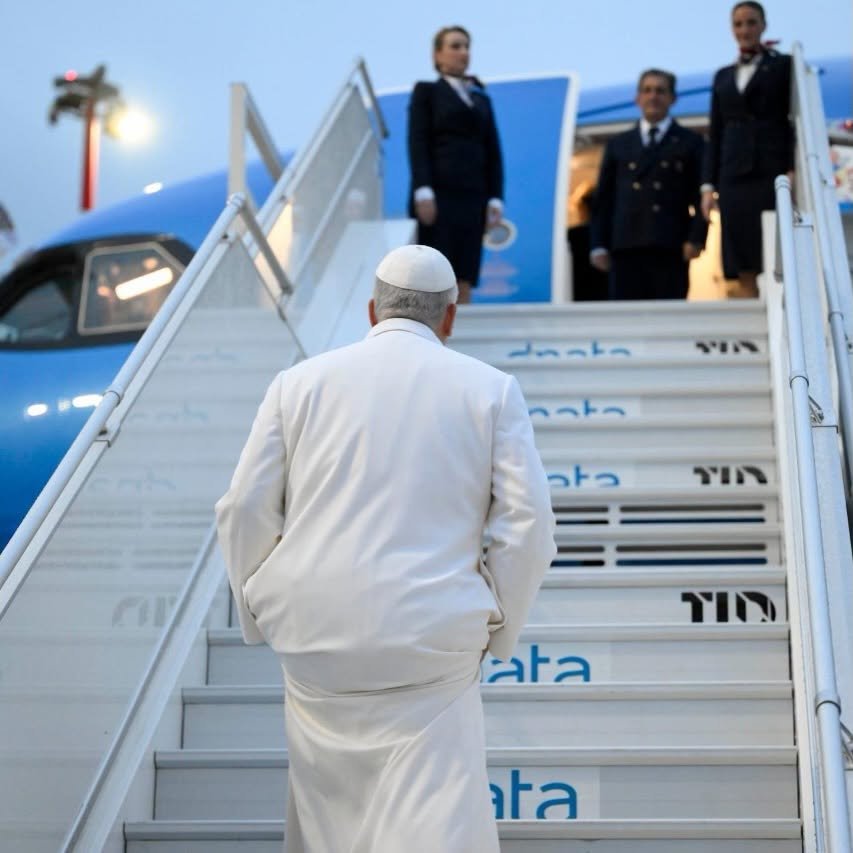
During his nearly 11,000-kilometer flight between Rome and Montevideo, Leo XIV sent messages of prayer and blessing to France, Algeria, Mauritania, Senegal, and Brazil. An ancient pontifical tradition that, in the first Augustinian Pope, finds a suggestive resonance in the thought of Saint Augustine.
The Pope’s apostolic journeys do not only begin when he steps off the plane and greets the authorities of the receiving country. They are also lived thousands of feet in the air. For decades, pontiffs have maintained the tradition of sending telegrams to the heads of state of the nations they fly over, accompanied by words of closeness, good wishes, and prayers for their inhabitants.
It is not, therefore, a custom inaugurated by Leo XIV. His predecessors also turned these messages into an expression of the universal dimension of their ministry. However, in the first Pope belonging to the Order of Saint Augustine, this practice allows us to discover a beautiful resonance with the spirituality of the Bishop of Hippo.
This Friday, November 6, 2026, during the flight that took him from Rome to Montevideo—the first stage of his apostolic journey to Uruguay, Argentina, and Peru—Leo XIV kept five nations from three continents in mind: France, Algeria, Mauritania, Senegal, and Brazil.
The Holy Father departed from Rome-Fiumicino airport at 7:05 AM aboard an ITA Airways Airbus A330-900 and landed in Montevideo at 4:19 PM local time. The journey, approximately 11,000 kilometers in air distance, was accompanied by these messages addressed to the respective heads of state.
A blessing for five nations
In the telegrams released by the Holy See Press Office, Leo XIV expressed various intentions for the countries he crossed.
While flying over France, he recalled his recent visit with gratitude and asked for peace and concord for its inhabitants. He also evoked his trip to Algeria, made earlier this year, and invoked the gifts of peace and prosperity upon that nation.
For Mauritania, the Pontiff asked for unity and concord, while passing over Senegal, he sent an affectionate greeting to its inhabitants and prayed for the country’s divine protection.
Finally, while crossing Brazilian airspace, he invoked the gifts of unity and peace upon the nation.
These are brief messages, typical of the Holy See’s diplomatic language, but they express a deeper reality: the pastoral closeness of the Bishop of Rome is not limited to the countries on his agenda.
Saint Augustine: a blessing that bears fruit and embraces all peoples
Although this pontifical tradition predates Leo XIV, its meaning can be read through two deeply Augustinian keys.
The first appears in Saint Augustine’s commentary on Psalm 66, where he reflects on the relationship between God’s blessing and the human response:
“His blessing is like the rain; ours is the fruit.” Saint Augustine, Commentary on Psalm 66, 1.
For Augustine, all blessing has its origin in God. The human being is not its owner, but the receiver of a grace that they are called to welcome and make fruitful.
From this perspective, the Pope’s words about the countries he flies over can be understood as a prayer that recognizes God as the source of peace, concord, and fraternity. It is not the Pontiff who produces these gifts by himself: it is God from whom he requests them for the people.
The second key is the universality of the Church. In that same commentary, Augustine insists that the way of Christ does not belong to one nation, one culture, or one particular group. The Christian faith is called to travel the world and gather peoples into communion.
That is why he exhorts:
“Walk on the way with all nations.” Saint Augustine, Commentary on Psalm 66, 6.
It is a particularly suggestive image for understanding the spiritual meaning of apostolic journeys. The Pope moves from one country to another, but his mission is not exhausted at the borders of his destinations. His prayer can also reach those he will not meet personally.
In Augustinian thought, walking with all peoples means recognizing that no one is excluded from the invitation to unity. And this finds a symbolic expression in this tradition of pontifical travel: even during the journey, nations are part of the spiritual pilgrimage of the successor of Peter.
Before leaving Italy, Leo XIV had also sent a telegram to President Sergio Mattarella, entrusting the desires for peace and fraternity of the peoples he would visit to the intercession of the Virgin Mary and the saint evangelizers.
Thus, the journey to Uruguay began under the sign of prayer and a closeness that transcends borders.
Perhaps one of the simplest messages of this day is precisely the one Leo XIV addressed to Brazil, invoking God’s gifts upon its inhabitants:
“I invoke the gifts of unity and peace from Almighty God upon the nation.”
Leo XIV, telegram to the President of Brazil, November 6, 2026. Translation from the English original.
Unity and peace. Two words that summarize the intentions of this pilgrimage and that find a deep harmony with the Augustinian ideal of living united in one heart and one soul directed toward God.
Because an apostolic pilgrimage is not measured solely by the kilometers traveled, the meetings held, or the countries visited. It can also be understood by the people and nations the Pope carries in his prayer.