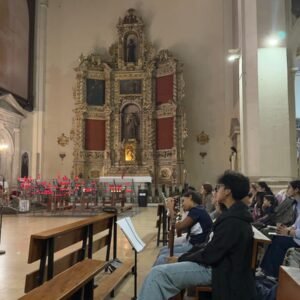
The Augustinians have been present in Barcelona since the first centuries after the founding of the Order of Saint Augustine. The first convent of Saint Augustine was built in 1349 in the Ribera district of Barcelona, the Gothic Quarter. Because of the construction of the Citadel fortress (1713–1714), the Augustinians had to move to the Raval district, where they are still today. Most of the old convent of Saint Augustine now houses Barcelona’s photographic archive, the Chocolate Museum and the Hotel San Agustín, but parts of the old convent, such as the west wing of the cloister, are preserved.
In the 19th century a series of events badly affected the Augustinian community, which had to leave. In 1835 the new convent suffered a serious fire during anticlerical riots. That same year, with Mendizábal’s Disentailment (a historical, economic and social process in Spain that began in the late 18th century), the Order of Saint Augustine lost the convent, which later came directly under the Archdiocese of Barcelona.
The Augustinians returned to this ecclesiastical jurisdiction in 1976, to Badalona, and in 2018, to the Raval district.
The community today
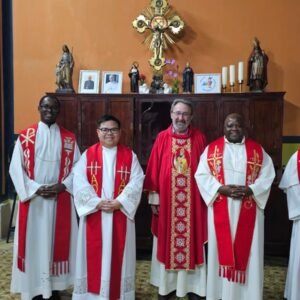
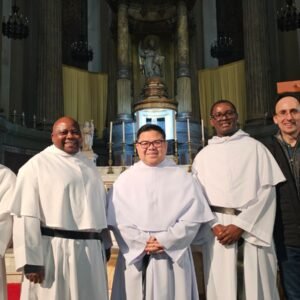
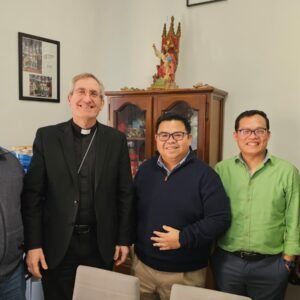
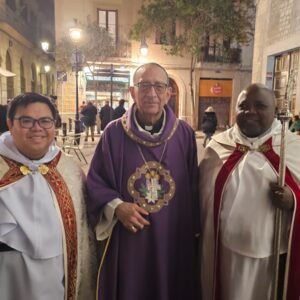
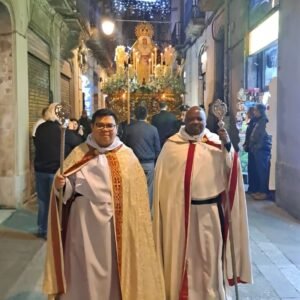
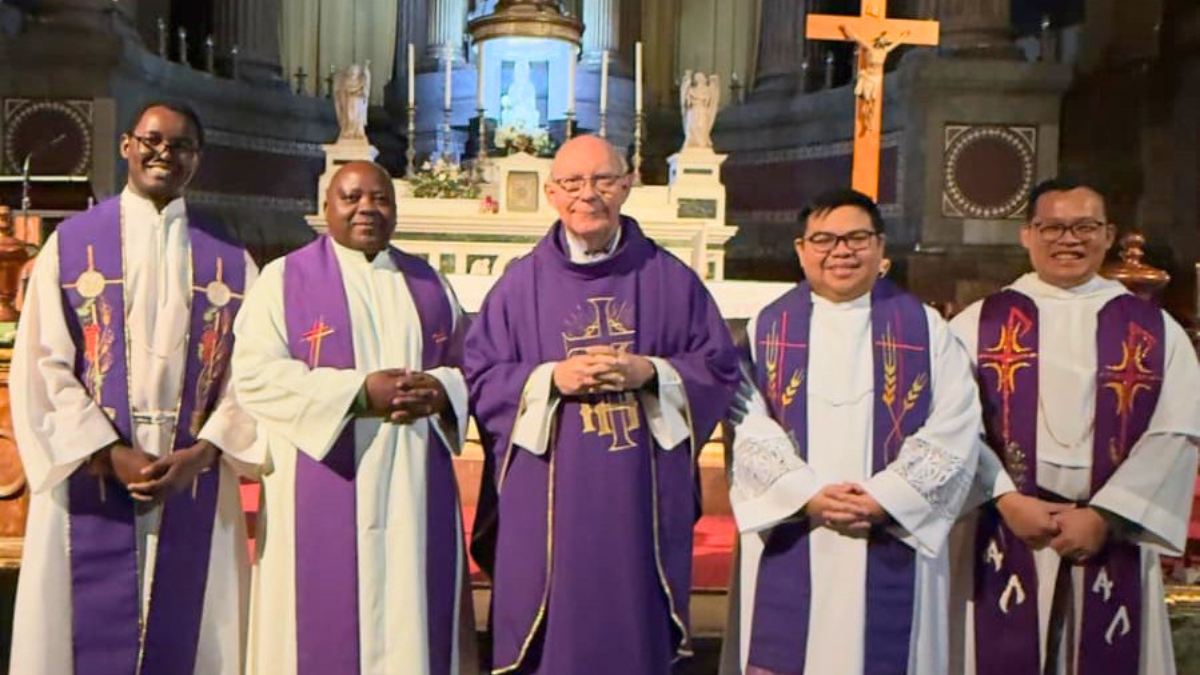
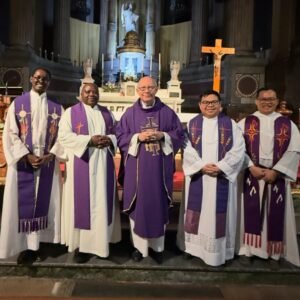
At present, the community is made up of four friars: Fr. Faustin John Mlelwa, Fr. Michael Go, Fr. Dennis Pineda Pineda and Fr. Laurent Joseph Temanya. It is a young, international community: two are from the Philippines and the other two from Tanzania. All four carry out various pastoral activities in a fraternal atmosphere, with an authentic religious life and a strong apostolic zeal. Their pastoral work takes place in three parishes of the diocese of Barcelona:
– Parish of Sant Roc, in the neighbourhood of the same name in Badalona. Besides the pastoral work of evangelization and the celebration of the faith, it promotes various educational, social and cultural projects for children, young people and adults, with special attention to groups at risk. This socio-educational work is carried out by the Ateneu Sant Roc Foundation, which has its premises in the parish buildings and works together with the parish and the Augustinian Province of Saint John of Sahagún.
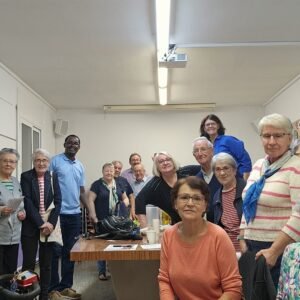
– Parish of Saint Augustine, in the heart of the city, in the Raval district. The community is dedicated to parish ministry, especially catechesis and the celebration of the sacraments. Christian communities from several Latin American countries also meet there, celebrating their own customs and devotions. The parish also collaborates with the Mano Amiga Foundation, which helps immigrants in the neighbourhood by distributing food and clothing.
– Parish of the Immaculate Conception and Saint Lorenzo Ruiz. It is a parish for the Filipino community living in Barcelona, which has its base there. The faithful receive pastoral accompaniment, with attention to their spiritual and community needs.
All three parishes have a clear mission of accompanying immigrants.
The community also offers other services, such as chaplaincy and the celebration of the sacraments in various religious communities, as well as volunteering in soup kitchens.
All these activities are carried out by the four friars in a spirit of collaboration, teamwork and shared responsibility, each according to his abilities. Their pastoral work is inspired by the Augustinian charism, oriented towards building community and seeking God in fraternity.
Parish of Saint Augustine
On his route through Barcelona, the Pope will make a very special stop at the Parish of Saint Augustine. It will be a moment with a strong social character. There, Leo XIV will meet organizations and groups that work with vulnerable people, from volunteers who hand out food to organizations that care for the homeless.
The church, away from the city’s best-known tourist routes, has for years been one of the main social refuges in the heart of the Raval. With unceasing charitable activity, the missionary work of the Augustinians in this community is plain to see.
As well as meeting the spiritual and material needs of the people who come to this parish community, the parish team helps many people of other religions because, as the parish priest says, poverty knows no creed.
Very close to the Parish of Saint Augustine work the Missionaries of Charity, the sisters founded by Teresa of Calcutta, who serve meals to more than 400 people every day and who will also be represented at the meeting with Pope Leo XIV.
The parish priest, the Augustinian Fr. Faustin J. Mlelwa, says the Pope’s visit is a huge boost to continue the pastoral work they have been doing and to carry on their mission with people from other cultures.
«What a joy to think,» says the Augustinian friar, «that when the Pope visits us, the eyes of the whole world will be on this humble place.»
The Augustinian Family
Besides the Augustinians, the Augustinian Missionary Sisters are also present in Barcelona, with a long educational history in Catalonia.
They arrived in the town of Gavà in 1907 and founded the Immaculate Conception School. They came to Terrassa in 1924, founding the Sacred Heart School. Two communities educate today’s generations in the Augustinian style and spirituality.
Both schools, with more than a thousand students, are state-subsidized and teach from early childhood education through the final years of secondary school.