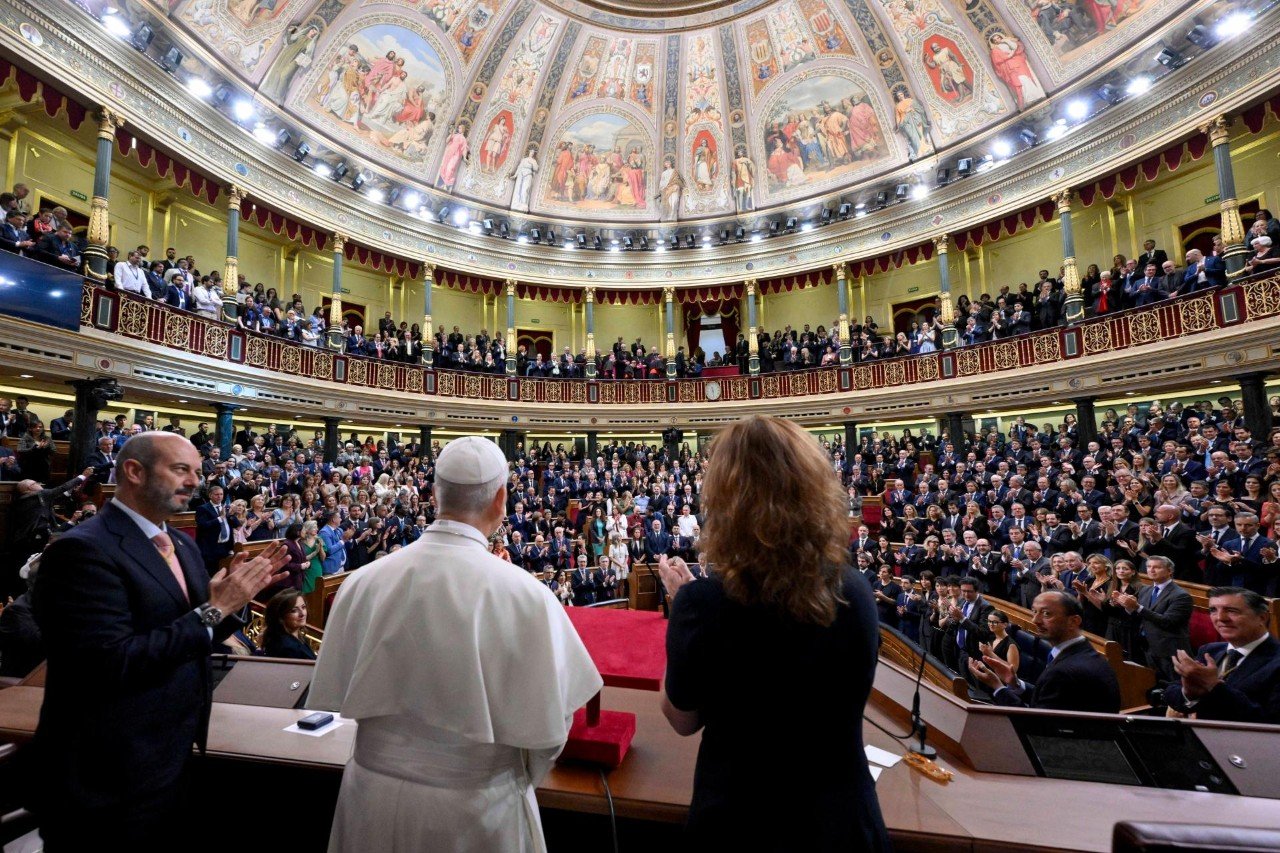
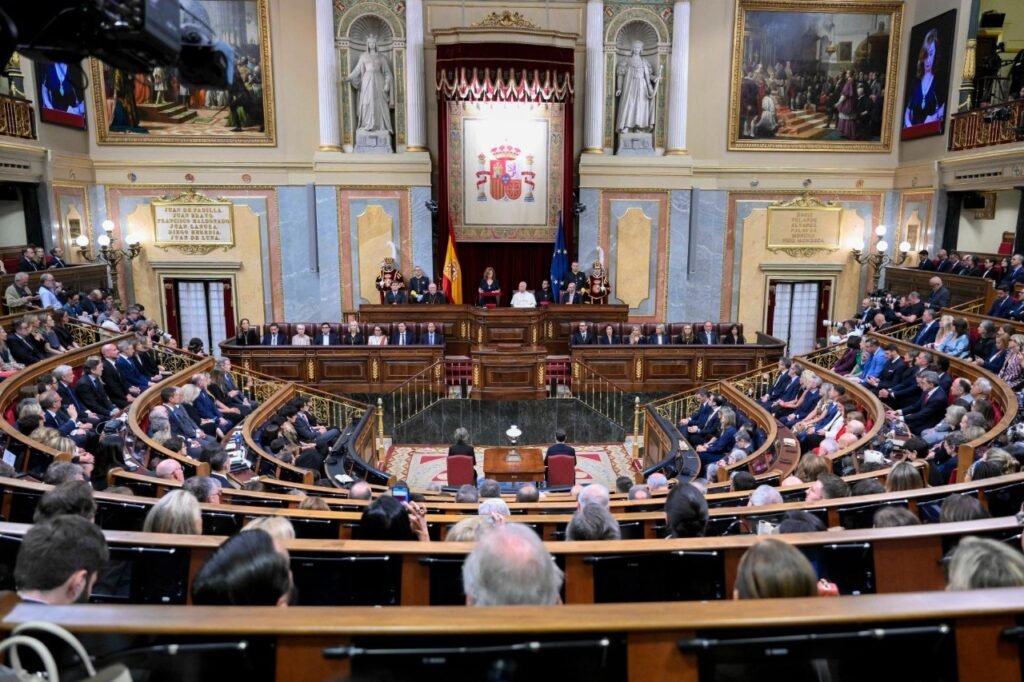
Shortly after receiving the head of government, the Pope went to the Carrera de San Jerónimo for a historic appointment.
After thanking Parliament for its invitation, Leo XIV began his address by recognizing the “rightful autonomy of earthly affairs” (GS 36). The Church does not seek to take over the proper functions of the institutions of the State. It is for the public authorities to determine the laws that govern society. The Church, for her part, is also at the service of the good of the person and of society. The Pope reviewed the contribution of the Church in Spain, throughout history, to the encounter between faith and reason. He highlighted in particular the work of the University of Salamanca in spreading the value of the human person and in developing the community of peoples (totus orbis).
The dignity of the person
As the Second Vatican Council said, although the Church is not bound to any political system, she must be free to pass “moral judgement”, even on political matters, when the fundamental rights of the person require it… (GS 76). That is why, in the central part of his address, the Pope briefly presented to our parliamentarians several fundamental themes of the Church’s moral teaching: the dignity of the person, the right to life, the common good, the family, education and migration. Every human being has an inviolable dignity, prior to and independent of its positive recognition by law. Life, especially the most vulnerable, must be protected from conception to natural death. The common good is the “social form of human dignity” (MH 59) and should prevail over particular interests. The State must safeguard the right to education and likewise the “primary and inalienable right” of parents to choose their children’s education. Both the right to emigrate and the “right to remain in one’s own land” (not to emigrate) must be promoted. International coordination is urgently needed to prevent human trafficking and to guarantee the safety, welcome and integration of migrants. Borders must stop being “places of abandonment” and become spaces where human dignity is protected.
Spiritual and cultural crisis
He then paused to analyse the “spiritual and cultural crisis” represented by today’s threats to world peace. He described the international scene and the need to respect international law and the means required to always put peace before the recourse to war. True security will not come from countries rearming, but from justice and patient negotiation.
In this context of a shared commitment to peace, Leo XIV’s message was a respectful invitation to dialogue instead of disparagement, to reconciliation and to seeking encounter, at a time of great tension in Spanish political life. We must also “disarm our words”, he said, because peace is not only a political or institutional matter but “a matter of conscience”. “Firmness does not require contempt; disagreement does not entail humiliation.”
Freedom of conscience and religion
The Pope called for freedom of conscience and religion, which must be protected by law. The legitimate non-confessional character of the State should never take the form of hostility towards religion, as unfortunately sometimes happens.
In the final part of his address, Leo XIV commented on some of the works of art in the chamber itself, marked by the Christian tradition, inviting a broad vision (“lifting up our eyes”), above all because political decisions have consequences, especially for the weakest, those who cannot make their voices heard. A law does not achieve greatness by being formally passed, but when it respects the dignity of the person and furthers the common good.
The Holy Father ended his applauded address with a hopeful wish: Spain can contribute a great deal to moral regeneration, to the value of concord and to just and peaceful coexistence in today’s world.
PHOTOS: © Vatican Media