

What is needed, then, is a risky work of synthesis, almost a telegraphic exercise, to highlight the axes that drive the Augustinian vision of God and of the human person. These are the two great themes that alternate in his thought. As he says in the Expositions on the Psalms, we are a coin that bears God’s stamp on one side and our own image on the other (Expositions on the Psalms 66,4). Affirming transcendence does not mean giving up or diminishing what is human; on the contrary, it opens up an immense continent to be discovered.
Around a few basic affirmations that give shape to Saint Augustine’s spirituality there is a whole list of key themes: happiness, love, community, truth, friendship, the way of beauty, the desire for fullness and for searching, peace, prayer, the permanent and unfinished sense of conversion, solidarity, the Eucharist, humility, and the figure of Mary, model of the Church and of the believer…
Among the emphases that define Saint Augustine’s spirituality, we could mention:
The Bible, wellspring of spirituality
Saint Augustine was a reader and commentator of the Bible. To read it is to come into contact with Jesus Christ, in whom the whole revealed word finds its deep unity. Many quotations illustrate this idea: “The Old Testament is the New veiled, and the New is the Old unveiled… The veil is removed so that what was obscure may be understood. The Old Testament was closed because the key of the cross had not yet come” (Sermon 300, 3).
The Word of God, as deep as it is fascinating (cf. Confessions 12, 14,17), is spiritual food and good news proclaimed that lays the foundations of the Kingdom of God in history. What God communicates through the Word is not his mystery: in revealing himself, he offers his communion and his life. The Bible “exhorts us to live well” (Expositions on the Psalms 90, 2, 1).
The centrality of the person of Jesus Christ
Christian spirituality and holiness spring from the person of Jesus Christ. In one of his famous sermons Saint Augustine says: “Christ heals, Christ purifies, Christ justifies” (Sermon 292, 6).
In the Confessions, Saint Augustine presents Christ as the mediator between God and humanity, the way, the truth and the life (7, 18, 24). And in The City of God he says: “There is only one sure way against all errors: that the same one be both God and man; God, where we are going; man, the way by which we go” (The City of God XI, 2).
Christ is the one true teacher (cf. Sermon 134,1; The Teacher 14,46), the truth that dwells in the inner self (Expositions on the Psalms 109,36), the Lord of history (cf. The City of God 8), the physician able to heal the sickness of sin (cf. Sermon 63 A, 2), food in the Word and in the Eucharist (cf. Sermon 56,10; Sermon 227,1).
We are all one in Christ, “many Christians and one Christ” (cf. Expositions on the Psalms 126, 3), and we are called to be Christ himself (cf. Tractates on the Gospel of John 21, 8). The motto on Leo XIV’s coat of arms, “In the One (Christ) we are one”, takes up the words Saint Augustine uses in the Exposition on Psalm 127,3 to explain that, although we Christians are many, in the one Christ we are one.
The whole Christ, foundation of unity and mercy
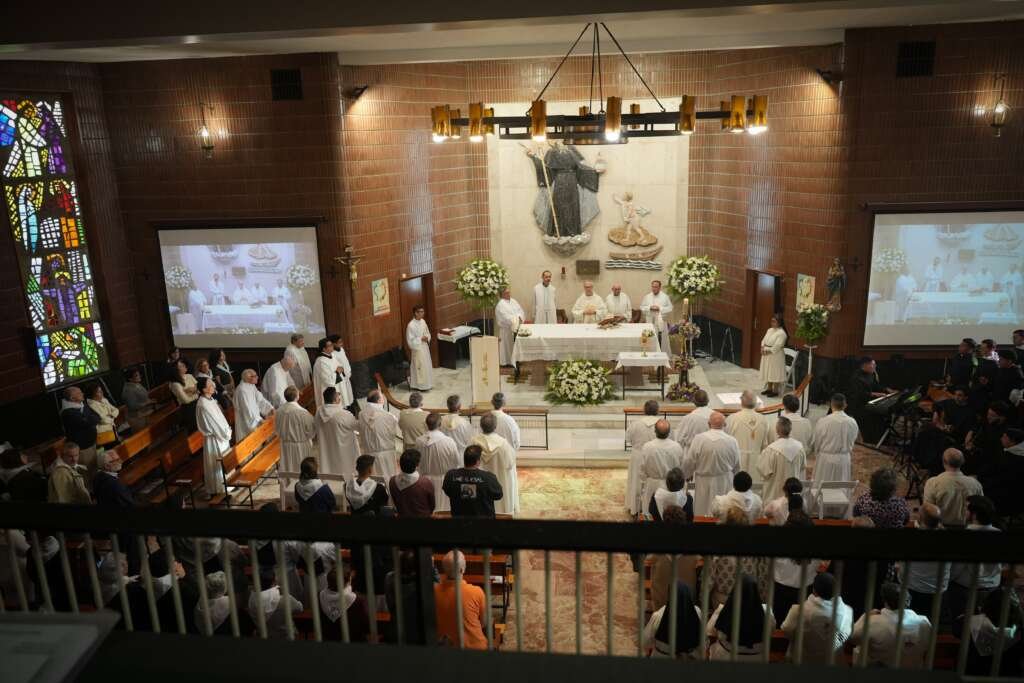 The union between the members and the Head makes us all one in Christ. This idea appears in many of Saint Augustine’s texts, such as Expositions on the Psalms 126, 3 or Sermon 341.
“What is the head and what are the members? Christ and the Church,” we read in the Tractates on the Gospel of John (21, 8). Paul’s text in 1 Corinthians 12:12-27 supports his reflection on the whole Christ. The image of the human body is very vivid, because everyone knows how the members and functions of their own body relate to each other.
God is served in the human person, particularly in the disadvantaged: “Christ is still in need here; he is still a pilgrim in this world, he falls ill and is imprisoned” (Expositions on the Psalms 86,5).
This Augustinian vision of the whole Christ is the deepest reason for caring for the fragile of the earth. Jesus’ humanity becomes present wherever there is human breath: “Do not complain, much less grumble, because you were born in these times when you cannot see the Lord in the flesh. You can; for he said: whatever you do to one of these little ones of mine, you do to me” (Sermon 103, 1, 2).
Charity, the soul of spirituality
Love and charity are terms Saint Augustine uses interchangeably, though sometimes with different nuances. Love, for example, can be disordered. He wisely warns: “Order your love. Look within, lest you love what you should not, or fail to love what you should. Order your love! Lest you love more what you should love less, or love less what you should love more” (On Christian Doctrine 1, 27,28).
Charity, by contrast, is “the movement of the soul towards enjoying God for his own sake, and oneself and one’s neighbour for God’s sake” (On Christian Doctrine 3, 10,16).
Saint Augustine looks over his personal history and the society around him and discovers that love is the driving force of life: “Each one lives according to what he loves” (The Trinity XIII, 20,26).
“Peoples too are defined by their loves. To see what a people is like, you must examine what it loves” (The City of God XIX, 24). If love withers, life is paralysed (cf. Expositions on the Psalms 85,24).
The fervour of his conversion did not lead Saint Augustine to live love in a purely vertical direction. “To love and to be loved” (Confessions 3, 1,1) was the task of all his days.
“Only a good love makes a life good,” he writes in Sermon 311,11. “What consolation is left to us in a human society like this, full of errors and hardships, but the unfeigned loyalty and mutual affection of good and true friends?” (The City of God XIX, 8).
Interiority and communion: places of great encounters
Interiority and communion are basic realities in the Augustinian narrative. Whoever is poured out and scattered among external things finds it hard to enter within (On Order 2, 11,30) and lives as an exile.
Only when a person enters within himself (On True Religion 39, 72,73), steps back from the life of the senses (On Order 1, 1,3) and returns to his heart (Tractates on the Gospel of John 18,10) is he able to know himself.
A person without interiority is a stranger to himself (Confessions 10,8), an anonymous being, without mystery, without curiosity. Interiority is the place of great encounters, of the deepest questions and the firmest certainties. “Return to your heart, and from there rise up to your God. If you return to your heart, you return to God from a place close by. If all these things trouble you, it is because you have gone out of yourself; you are an exile from your own heart. You are moved by the things outside and you lose yourself” (Sermon 311, 14,13).
Interiority is the root of one’s own life, the home of truth (cf. The Teacher 11,38), the place for listening to the inner Teacher and recognizing the truth that the human being carries imprinted within (cf. Letter 19,1). Saint Augustine discovers God as one more intimate to him than his own inmost self (Confessions 3, 6,11).
Sense of the Church
It is one of the unmistakable traits of Augustinian spirituality: “Love the Church, which has begotten you for eternal life” (Sermon 244, 1).
The passing of the centuries and so many human traces have clouded the purest image of the Church. “We have often said, and we will say it as often again, that the Church has chaff and wheat. Let no one try to remove all the chaff before the time of winnowing comes” (Expositions on the Psalms 25, 2,5). Saint Augustine accepts and loves the Church of his time above all human weaknesses and the poor example of some of its members. “Love the Church, for she has begotten you to eternal life” (Sermon 344,2).

At the service of evangelization
Evangelization is “a duty of love”, he says in the Tractates on the Gospel of John (123, 5). “If I do not share the Word of God, if I keep the treasure to myself, the Gospel terrifies me,” he says in one of his sermons (Sermon 339,4).
The old dilemma between action and contemplation finds a harmonious solution in Saint Augustine. The mystical dimension, or interiority, flows into evangelizing action: “I must have the greatest care for the Church entrusted to me. I am at the service of whatever may be useful to her; I wish not so much to preside over her as to be of use to her” (Letter 134,1).
In an almost excessive pastoral zeal, Saint Augustine exclaims: “I do not want to be saved without you” (Sermon 17,2). The house of God is the whole earth, and it is built up by reading his word, by love and by preaching the Gospel, he writes in the Exposition on Psalm 95.