
Bishop Miguel Ángel Cadenas in Pucallpa: “Mistreating the land and creation is mistreating indigenous peoples”
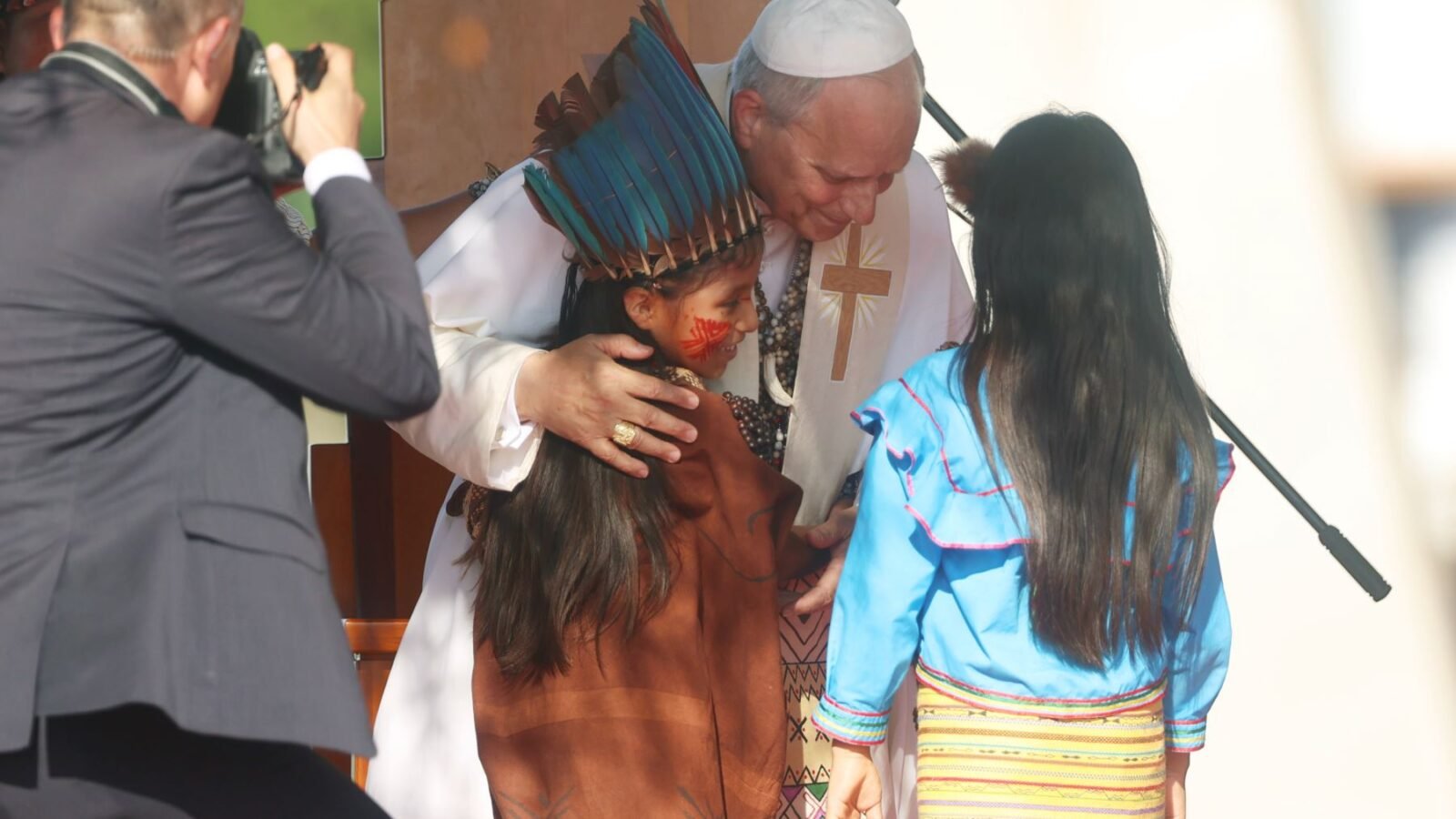
The Bishop of the Apostolic Vicariate of Iquitos, Msgr. Miguel Ángel Cadenas, OSA, participated yesterday in Pope Leo XIV’s celebration with indigenous peoples at the “Ucayali Regional Sports Village” in Pucallpa. At the end of the Eucharist, he shared with Agustinos con el Papa his first impressions of this encounter and the message from the Pontiff, who emphasized the relationship between the defense of human dignity, social justice, and the care of creation.
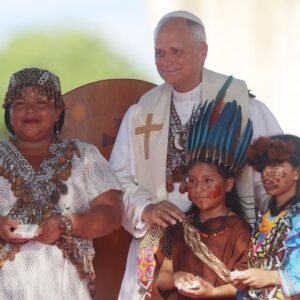
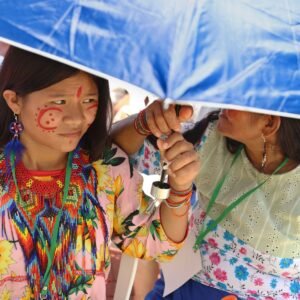
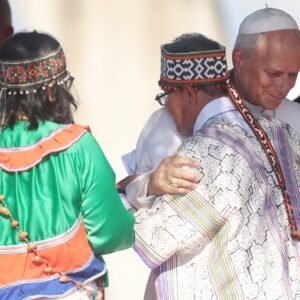
Pucallpa is an Amazonian city surrounded by the peoples of the Pano linguistic family. For them, clothing is not just an outfit; it is part of the body, it is the body. Thus, the cushma or tunic is a second skin. This allows for a connection with cosmology, linking them to spiritual beings and the territory. Nothing is incidental. The designs and dyes they use go beyond mere decoration and convey ancestral knowledge. In such a way, those who see them perceive a different universe. Or rather, we could say a pluriverse, fostering an openness to reality or to the other-reality.
The meaning of attire and colors
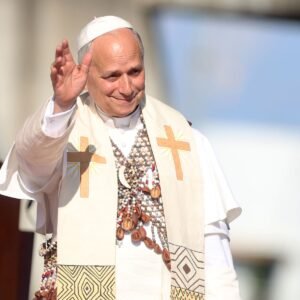
If indigenous clothing and body ornaments are important, the Pope’s attire is equally so: all dressed in white. In kené, a design among the Pano peoples, white serves as the background upon which designs are drawn, aiding in proportion, balance, and harmony. In contrast to the Pope, we bishops were dressed in black cassocks with piping. For the Pano, the color black helps highlight the red and yellow achieved with different types of clay. Both white and black are related to the moon.
The event with the Pope included music and various dances. Dance is the body in motion. These were not merely aesthetic elements to decorate the event. Rather, they are powerful transmitters of messages for those who know how to decipher them. The same could be said of the gifts offered to the Pope. This establishes a bond between the giver and the receiver. Therefore, the indigenous people gave various objects to the Pope, and he reciprocated with others. A gift is an extension of the person. The gifts the Pope receives are artifacts that will remind him of the need to pray for those who gave them, thus helping to protect them from all evil. Likewise, the gifts offered by the Pope are powerful protectors against evil spirits, and the indigenous world is a continuous struggle against evil spirits. That is why they are so important. In this context of clothing, body paint, music, and dances… the speeches acquire greater depth.
The memory of distinguished missionaries
The word, in addition to describing reality, also constructs it. The indigenous people told Pope Leo XIV that, since Pope Francis’s visit in 2018 to Puerto Maldonado until now, the situation has worsened for the Amazon and for them. But they did not stop at lamentation; they expressed that they have hopes and dreams and asked the Pope to help them position their discourse so that they may be heard.
It was particularly gratifying when they named some distinguished missionaries: the Dominican José Alvarez, known as Apaktone, the “old father” who dedicated his life to the Harakbut; the Salesian Fr. Luis Bolla among the Achuar; and other missionaries. The encounter was organized by the sisters of the Missionary Society of the Sacred Heart of Jesus, who have dedicated their entire lives to the Shipibo people.
The connection between human dignity and the care of creation
The Pope responded with a powerful speech indicating that mistreating the land and creation is mistreating indigenous peoples. You can read the Pope’s homily on the Vatican website. We want to highlight that Pope Leo XIV has come to Pucallpa to confirm us in the faith. This is very important for us and we are very joyful. Pucallpa has been in a festive mood and the indigenous peoples are grateful for his visit. We missionaries who are fortunate enough to live in the Amazon feel comforted by his presence and his words, by his gestures and his closeness, by his affection and encouragement. Thank you very much, Pope Leo XIV; we thank you for accompanying us in the following of Jesus Christ.